AMR & AGVs
What Autonomous Mobile Robots Can and Cannot Do in 2026
Jun 24, 2026 · 16 min read · Robotech Pros
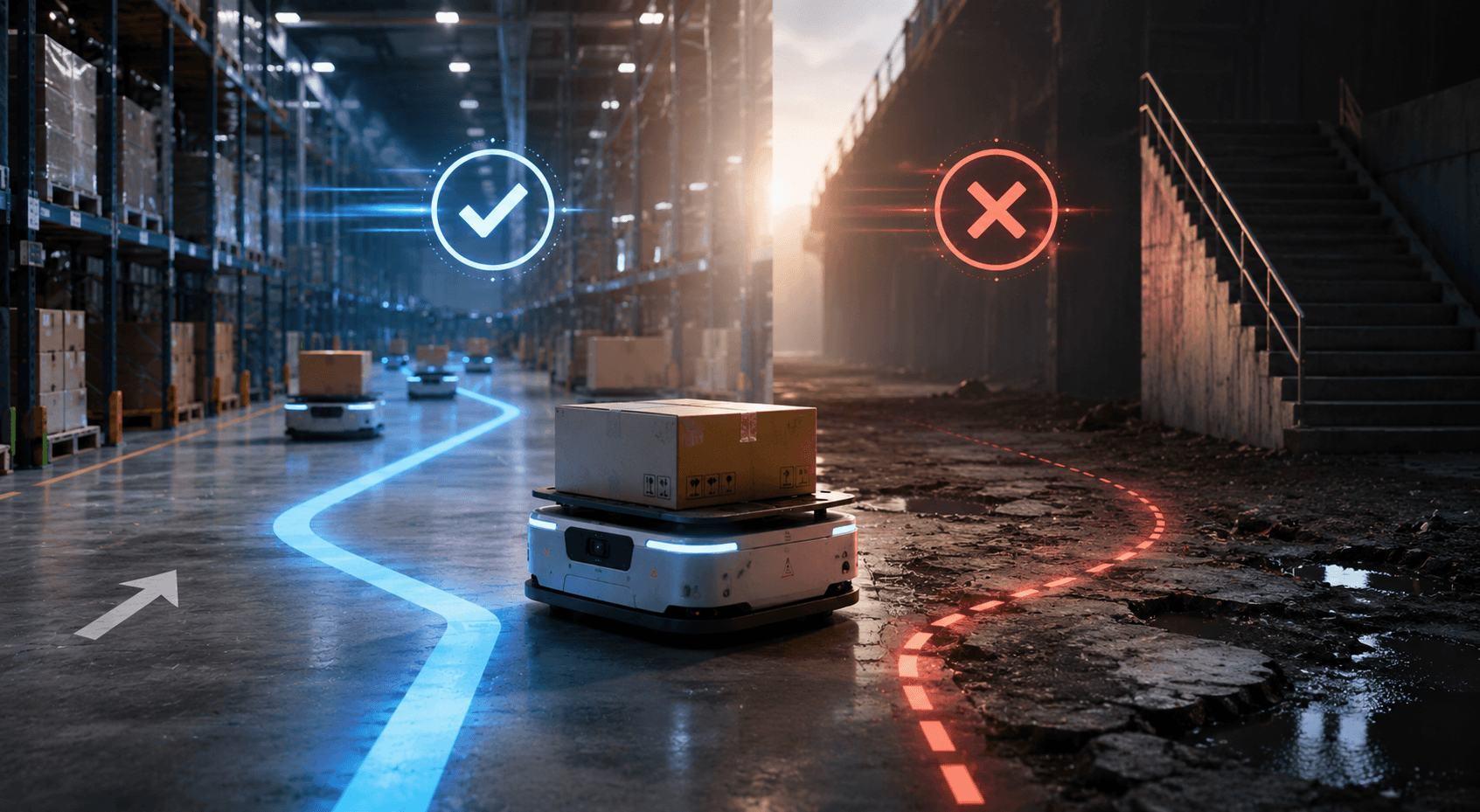
Can Autonomous Mobile Robots solve your biggest warehouse challenges? Explore what AMRs can and cannot do in 2026, their real-world limitations, and where they create the strongest ROI.
The conversation about autonomous mobile robots tends to go to one of two places. Either AMRs are presented as a comprehensive automation solution that will solve most warehouse movement challenges, or operations teams dismiss them as limited tools that only work in controlled conditions.
Neither framing is accurate, and both lead to poor decisions.
In 2026, AMRs are meaningfully more capable than they were five years ago. Navigation has improved, fleet management software has matured, and the range of compatible use cases has expanded across warehousing, manufacturing, and logistics. At the same time, there are real things AMRs cannot do, and understanding those boundaries is just as important as knowing where the technology performs well.
This article covers both sides honestly, so operations teams and business leaders can approach AMR decisions with a clear picture of the technology as it actually stands.
What Makes AMRs Different from Other Automation Options
Autonomous mobile robots navigate using onboard sensors, typically a combination of LiDAR, cameras, and depth sensors, combined with mapping software that allows the robot to understand its environment in real time. This is what separates them from automated guided vehicles (AGVs), which follow fixed paths defined by magnetic tape, optical markers, or laser guides embedded in the floor.
Because AMRs build and maintain a dynamic map of their environment, they can adjust routes on the fly when obstacles appear, whether that is a pallet in an aisle, a forklift moving through an intersection, or a worker walking across the path. That flexibility is the core operational advantage AMRs offer.
They do not require infrastructure changes to adjust their routes. If a facility's layout changes, AMRs can be remapped relatively quickly. That adaptability has made them practical for a broader range of facilities than the infrastructure-intensive systems that came before them.
What AMRs Can Do in 2026
Modern AMRs handle a significant range of tasks in warehouse, distribution, and manufacturing environments. The most well-established capabilities include autonomous navigation in dynamic environments, horizontal goods transport across a facility, goods-to-person picking support, self-charging, fleet coordination via management software, WMS and WES integration, and operational data collection.
Navigation capability has improved notably. Using safety-rated laser scanners and sensor fusion, AMRs detect obstacles, slow down, and reroute without operator intervention, making them viable in mixed human-robot environments without dedicated safety zones in most facility layouts.
Fleet management software has also matured considerably. Multiple AMRs can now operate together with coordinated path planning, dynamic task distribution, and traffic management that prevents deadlocks and optimizes routing across large operational areas.
Table 1: What AMRs Can and Cannot Do in 2026
| What AMRs Can Do | What AMRs Cannot Do |
|---|---|
| Navigate dynamically around obstacles using SLAM and LiDAR | Pick or manipulate individual items without an arm attachment |
| Transport goods horizontally across a facility | Climb stairs or navigate multi-floor layouts independently |
| Support goods-to-person picking workflows | Operate in most outdoor or harsh weather environments |
| Operate autonomously in mixed human-robot environments | Function in very narrow aisles below minimum width |
| Self-dock for charging when battery is low | Work in freezer storage without purpose-built configuration |
| Coordinate across a fleet via fleet management software | Make strategic decisions or handle exception workflows |
| Integrate with existing WMS and WES platforms | Self-repair when mechanical issues arise |
| Collect and report operational movement data | Lift oversized loads beyond rated payload capacity |
| Remap routes without infrastructure changes | Hospitality-focused robots (e.g., Slamtec Food Delivery Robot F3 and Slamtec Hotel Robot H2) are designed specifically for food delivery and hotel services, not industrial warehouse transport. |
Core capability and limitation overview for commercial AMRs in warehouse and manufacturing environments.
Where AMRs Still Fall Short
The limitations are real, and understanding them matters as much as the capabilities. AMRs cannot pick items independently. Navigation is not the same as manipulation. Most commercial AMRs move items from place to place; they do not reach into shelving, handle product, or perform physical picking without a separate robotic arm attachment. Autonomous mobile manipulators that combine navigation with arm-based picking exist, but they are still developing and carry significant cost and complexity compared to standard AMR deployments.
AMRs cannot climb stairs or access multiple floor levels on their own. They operate on flat surfaces. Facilities with mezzanines, multi-story structures, or significant elevation changes need separate solutions for vertical movement.
Standard AMRs are not designed for outdoor operation. Most commercial warehouse AMRs are built for controlled indoor environments. Rain, uneven ground, and temperature extremes are beyond the operational tolerance of most current systems.
Floor conditions matter more than vendors typically communicate upfront. Cracks, surface irregularities, slopes beyond a few degrees, and uneven expansion joints can affect AMR navigation. Most commercial AMRs operate within approximately 0 to 40 degrees Celsius. Cold storage environments, particularly freezers, require purpose-built or specially rated systems.
AMRs also do not replace human judgment in exception handling. When an unusual situation occurs on the floor, a human still needs to intervene. AMRs execute within defined task parameters; they do not make strategic decisions or solve problems outside their programming.
AMR Types and the Tasks They Handle Best
The term AMR covers several distinct robot categories, and each handles different operational tasks. Choosing the right type depends on the specific workflow, not on AMRs as a general category. A goods-to-person system that works well in a high-volume e-commerce operation would be a poor fit for a manufacturing line-side delivery task that a transport AMR handles reliably.
Table 2: AMR Types and Their Primary Use Cases
| AMR Type | Primary Application | Best-Fit Environment |
|---|---|---|
| Collaborative Picking AMR | Follows workers through pick paths, carrying totes or carts | E-commerce fulfillment, high-SKU distribution centers |
| Goods-to-Person AMR | Brings inventory pods or shelving to stationary pick stations | High-throughput order fulfillment, zone-based picking |
| Transport AMR (cart/tote mover) | Moves carts, totes, and goods between defined zones | Manufacturing line-side delivery, staging and dock transport |
| Autonomous Forklift AMR | Lifts and transports pallets autonomously on defined routes | Pallet putaway, storage replenishment, dock-to-shelf transport |
| Autonomous Mobile Manipulator | AMR combined with robotic arm for picking and placing items | Emerging: case picking, depalletizing (still developing commercially) |
Overview of common AMR categories, their primary applications, and the environments where each performs best.
Where AMRs Perform Well vs. Where to Proceed with Caution
Not every facility is equally suited for AMR deployment. The environments where AMRs tend to perform best share a few common characteristics: defined workflows with repetitive movement patterns, stable layouts, reasonable aisle widths, and managed floor conditions.
Environments with highly variable product handling, irregular layouts, or significant physical constraints need more careful evaluation before committing to a deployment. The table below summarizes the key facility factors that affect AMR performance.
Table 3: Facility Readiness for AMR Deployment
| Facility Factor | Where AMRs Perform Well | Where to Proceed with Caution |
|---|---|---|
| Aisle width | 2m or wider with clear travel paths | Below 1.5m or highly congested with fixed racking |
| Floor condition | Smooth, level concrete with well-maintained joints | Cracked, uneven, or steeply sloped surfaces |
| Wi-Fi coverage | Consistent coverage throughout operational area | Coverage gaps or interference-prone environments |
| Temperature | Ambient environments between 0 and 40 degrees Celsius | Cold storage below 0 degrees Celsius (requires specialist config) |
| Workflow structure | Repetitive, defined movement with stable routes | Highly variable tasks requiring frequent judgment calls |
| Layout stability | Relatively stable layouts over time | Frequently reconfigured layouts requiring constant remapping |
| Product type | Standardized items in totes, carts, or pallets | Irregular, fragile, or highly varied products |
Facility factors that support strong AMR performance versus conditions that require additional evaluation before deployment.
AMR vs. Traditional Automation Approaches
Operations teams evaluating AMRs often compare them against AGVs or fixed conveyor and sortation systems. Each has its place, and the comparison depends heavily on the specific workflow rather than which system sounds more advanced.
Table 4: AMR vs. AGV vs. Fixed Automation
| Factor | AMR | AGV | Fixed Automation |
|---|---|---|---|
| Navigation method | Autonomous path planning via SLAM and onboard sensors | Fixed guide paths (magnetic tape, lasers, optical markers) | Fixed physical infrastructure (conveyors, tracks, sorters) |
| Infrastructure required | Minimal: Wi-Fi and clear paths | Significant: floor guides and rigid routes | High: permanent installation and fixed routing |
| Flexibility | High: routes reconfigured without physical changes | Low: path changes require infrastructure rework | Very low: major capital investment to reconfigure |
| Typical payload | 100 to 1,500 kg depending on type | 500 to 5,000+ kg for heavy-duty systems | Throughput-based, not payload-rated per unit |
| Best for | Dynamic environments, variable workflows | Fixed-route, high-volume, heavy-load transport | High-volume, predictable flows with stable product types |
| Scalability | Add or remove robots incrementally | Constrained by fixed infrastructure investment | Requires significant capital to expand capacity |
Operational comparison across three common automation approaches. The right choice depends on workflow requirements, not technology preference.
The right comparison is always workflow-specific. An AMR that performs excellently in a goods-to-person picking operation may be a poor fit for a long-range pallet transport task that a counterbalanced AGV handles reliably. The technology does not determine the outcome; the workflow match does.
What Operations Leaders Should Evaluate Before Committing
Understanding AMR capabilities and limitations is the starting point. The more specific questions involve your facility, your workflows, and your operational goals.
Which movement tasks consume the most labor hours today? Where does material movement create bottlenecks in throughput? What are the current aisle widths, floor conditions, and Wi-Fi coverage in the target area? How would AMR tasks integrate with your existing WMS or WES? What does the deployment timeline and integration resource requirement look like realistically?
These questions matter because AMR performance is only as good as the workflow it is designed to support. A system well-matched to an actual operational bottleneck delivers measurable results. A system chosen based on vendor demonstrations, without clear workflow alignment, tends to underperform expectations.
Deployment timelines are another area where realistic expectations help. End-to-end AMR deployments, from site assessment through scaled operations, typically take longer than vendor timelines suggest. IT integration, staff training, route commissioning, and operational fine-tuning all add time that should be accounted for in the planning phase. Contact our team if you would like a professional assessment of your facility's readiness.
How Robotech Pros Can Help
Evaluating AMR options without operational context is difficult. The range of available systems, the variation in vendor capabilities, and the operational specifics that determine deployment success all require careful assessment before a commitment makes sense.
Robotech Pros works with operations teams to assess where autonomous mobile robots create genuine value, which specific workflows they should target first, and what facility preparation is typically needed before deployment. The goal is a practical deployment plan grounded in actual operational conditions, not vendor demonstrations.
If your team is beginning to evaluate AMR options, or if you have questions about where mobile robotics could support your facility, a workflow-focused assessment is a practical place to start. Explore our comprehensive assessment and integration solutions on our Services page.
Frequently Asked Questions
What is the typical payload capacity of an autonomous mobile robot?
Payload capacity varies significantly by AMR type. Collaborative picking AMRs designed to carry totes typically handle 100 to 300 kilograms. Heavy-duty transport AMRs for pallet movement can carry 1,000 to 1,500 kilograms or more depending on the system. Selecting the right payload rating for your specific materials is a critical part of the evaluation process.
How long does AMR battery life last, and does the robot need to stop to charge?
Most commercial AMRs offer 8 to 10 hours of operational runtime per charge cycle. Many systems use opportunity charging, where the robot briefly docks during task pauses rather than taking extended charging breaks. This approach supports near-continuous operation across long shifts when the charging infrastructure is designed to support it.
Do AMRs require physical infrastructure changes to the facility?
Unlike AGVs, AMRs do not require guide tape, floor markers, or structural changes to navigate. However, they do have practical requirements: consistent Wi-Fi coverage throughout the operational area, adequate aisle widths, suitable floor conditions, and integration access to the WMS or WES. Facilities that lack any of these typically need to address them before deployment proceeds.
Can a facility use AMRs if it already has a WMS in place?
Yes, in most cases. AMRs communicate with fleet management software, which integrates with the WMS via API. The integration process requires IT involvement and typically takes several weeks to configure and test. The specific scope depends on the WMS platform, the AMR vendor's software, and the task logic the facility needs to support. To learn more about the team behind these deployments, visit our About Us page.
Related resources
Warehouse Automation KPIs: What to Measure Once the Robots Are Running
A deployed fleet produces a great deal of data and surprisingly little information. These are the metrics that tell you whether the robots are healthy, doing the right work, and paying for themselves.
When Not to Automate: Five Operations Where Robotics Is the Wrong Answer
Most automation content explains when to start. This one explains when to stop: five operating profiles where mobile robotics disappoints, with a measurement you can run before anyone quotes a fleet.
How Many AMRs Do You Actually Need? A Guide to Throughput Modeling
Most AMR fleet sizes are guessed before anyone counts the moves. This guide walks through the four-step throughput model that replaces the guess, and explains why doubling throughput takes more than double the robots.