AI and Robotics
What Is Physical AI, and What Does It Change on the Warehouse Floor?
Nov 15, 2026 · 18 min read · Robotech Pros
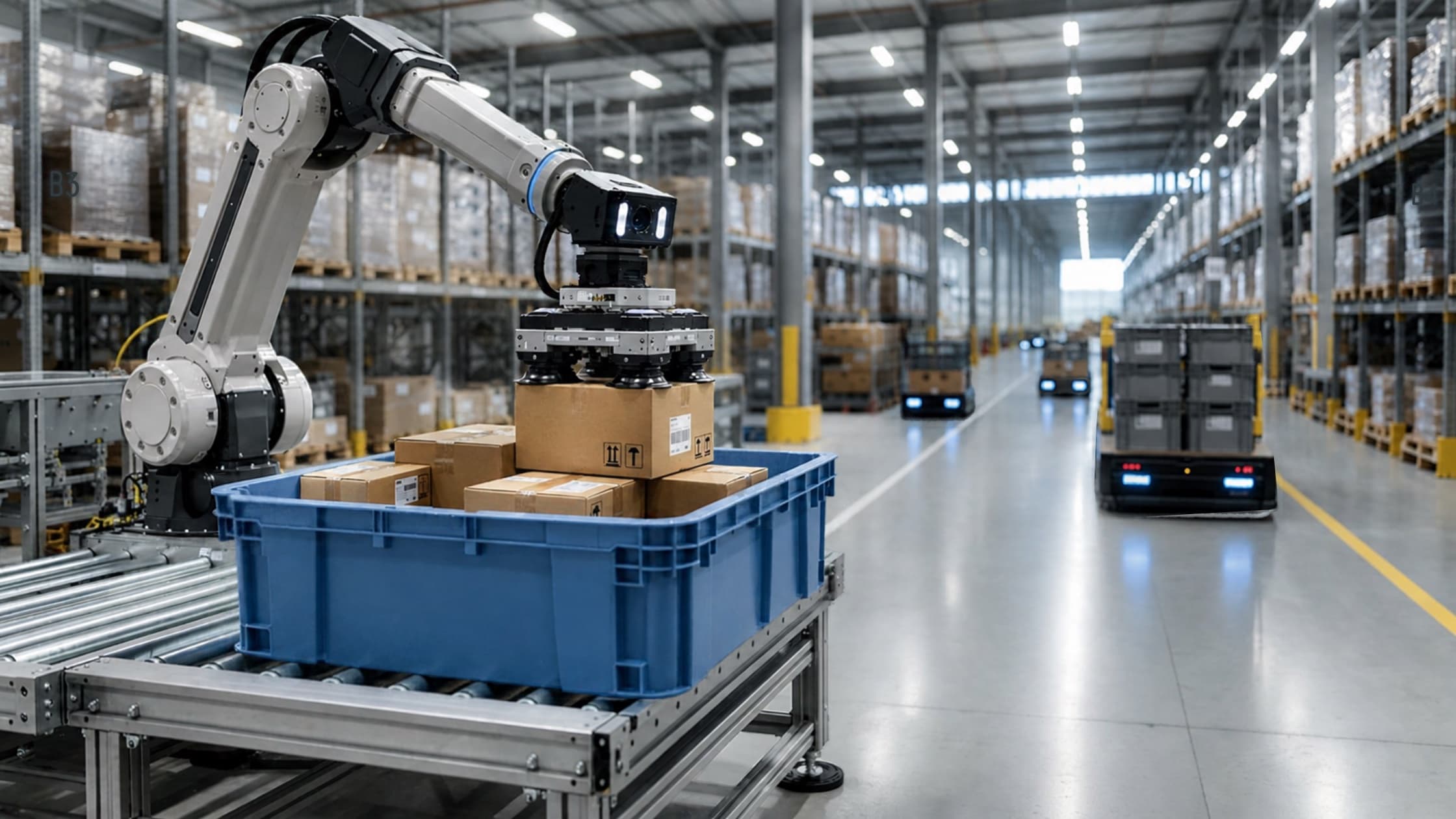
Physical AI is the name for robots that learn to sense, decide, and act instead of only following fixed rules. This guide explains what the term means, where it already changes warehouse work, and what is still unproven.
What Is Physical AI, and What Does It Change on the Warehouse Floor?
“Physical AI” moved from conference keynotes into planning documents very quickly. Gartner listed it among its top strategic technology trends for 2026. Deloitte gave it a full chapter in Tech Trends 2026 and named warehousing and supply chain as the earliest adopters. Many robotics vendors now use the term somewhere on their websites.
For an operations leader, the label matters less than two practical questions. What can these systems do on a real warehouse floor today, and what is still a demo? This guide answers both. It keeps a clear line between what vendors say and what has been shown in daily operation.
What is physical AI?
Physical AI is artificial intelligence that senses the physical world, decides what to do, and acts through a machine, such as a robot arm, a mobile robot, or an autonomous forklift. A chatbot produces text. A physical AI system produces movement, so its mistakes are also physical: a dropped item, a blocked aisle, or a stopped conveyor.
The industry definitions say much the same thing. NVIDIA describes physical AI as the technology that lets autonomous machines perceive, understand, and perform complex actions in the real world. Deloitte adds that this happens in real time. Gartner’s version is the shortest: machines and devices that “sense, decide, and act.”
Robots are not new to warehouses, so it is fair to ask what is new. The answer is how the robot’s behavior is produced. In classic automation, engineers write rules for each item, position, and exception. In physical AI, a large part of that behavior is learned from data: camera images, sensor readings, demonstrations by human operators, and large amounts of simulation. That is why the same model can sometimes handle an item it was never programmed for. It is also why its failures are harder to predict.
How physical AI differs from the automation you already run
Most warehouses already run a lot of automation that works well without any learning. Conveyors, sorters, shuttle systems, and many AGVs follow fixed logic. In a stable process, fixed logic is an advantage. It is predictable, easier to certify, and easier to troubleshoot. The difference appears when the work changes.
Table 1: Rules-based automation compared with physical AI
| Rules-based automation | Physical AI | |
|---|---|---|
| How behavior is defined | Engineers program rules, paths, and grip points | A model learns behavior from sensor data, demonstrations, and simulation |
| New SKU or packaging | Often needs new programming or teaching | May work without changes, but must be tested on the real item |
| Unexpected situations | Stops and raises a fault | Tries a recovery, then hands off to a person if it cannot |
| How it improves | Engineering change requests | Model updates trained on more data, often delivered by the vendor |
| How you validate it | Test the defined cases | Test a large, representative sample of your own items and conditions |
| Typical failure | Predictable and repeatable | Can be less frequent in variable work, but harder to predict |
| What you depend on | Your integrator and controls team | The vendor’s data, model updates, and support |
Simplified comparison. Many real systems combine both, for example a learned vision model that chooses grasp points inside a rules-based safety and workflow layer.
The “typical failure” row matters most. Physical AI does not remove failure. It changes the type of failure, and that changes how you test, how you staff exceptions, and what you need in the vendor contract.
The building blocks behind the term
Physical AI is an umbrella term. In a warehouse, it usually means one or more of the technologies below working together. It helps to know which one a vendor is actually selling. Vision-language-action (VLA) models take camera images and an instruction and turn them into robot motion. Many use two parts: a slower model that understands the scene and plans, and a fast controller that moves the arm or body. Figure’s Helix model, for example, runs a 7 billion parameter planning model 7 to 9 times per second and a separate control model 200 times per second. The split exists because planning is slow and a moving arm cannot wait.
World models and simulation create training data that would be too slow or too risky to collect on a live floor. Digital twins apply the same idea to the whole building, so layouts and robot fleets can be tested in software before anything changes on site.
Table 2: The main building blocks of physical AI in warehouses
| Building block | What it does | Example | Status, as published by the company |
|---|---|---|---|
| VLA and robot foundation models | Turn camera input and instructions into arm or body movement | Google DeepMind Gemini Robotics 2, NVIDIA Isaac GR00T N1.6 | Gemini Robotics 2 VLA is limited to early-access partners. GR00T N1.6 is an open model for developers |
| Fleet foundation models | Predict traffic and coordinate hundreds of robots at once | Amazon DeepFleet | Used in Amazon’s network. Amazon says it will improve fleet travel efficiency by 10% |
| Touch and force sensing | Lets a gripper feel contact and adjust its grip | Amazon Vulcan | In operation at Amazon sites in Spokane and Hamburg |
| World models and synthetic data | Generate realistic training scenes from simulation | NVIDIA Cosmos | Released to developers in January 2025 |
| Warehouse digital twins | Test layouts, fleets, and staffing in software first | NVIDIA Mega blueprint, used by KION with Accenture | Early adopter stage, no published results yet |
| AI assistants for operators | Answer operational questions in plain language | Amazon Project Eluna | Piloted at a fulfillment center in Tennessee |
Status details come from the companies named. “In operation” means the company says the system runs in daily work, not that independent results are published.
One point stands out in this table. The most mature examples, fleet coordination and touch sensing, are the least dramatic. They improve a system that already works. The most impressive demos, general-purpose models that drive a humanoid body, are still the least proven at warehouse scale.
What physical AI changes on the warehouse floor
The real changes so far are task-specific. They show up where the work has too much variety for fixed rules: mixed items, messy trailers, and busy robot traffic.
Picking and stowing mixed items
Each-picking has always been the hard part of warehouse automation, because items vary so much in shape, weight, and packaging. Amazon’s Vulcan robot uses force sensors so it can feel what it touches. Amazon says Vulcan can pick and stow about 75 percent of the item types stored at its fulfillment centers, at speeds comparable to front-line employees. It works mainly on the highest and lowest storage pod rows, which people otherwise reach with a ladder or by bending down.
The detail worth noticing is the handoff. When Vulcan cannot handle an item, it asks a person to take over. That is the realistic model for AI picking today: a robot that covers a larger share of the catalog, plus a designed process for the rest. The share it cannot handle, and how quickly that work reaches a person, decide the business case.
Trailer unloading and loading
A trailer is a good example of a space where fixed rules break down. Boxes shift in transit, sizes vary, and every load is different. Boston Dynamics launched Stretch Gen 2 in November 2026 and rates it at up to 1,000 cases per hour, while stating that the rate depends heavily on case weight and how neatly the cases are stacked. DHL signed a memorandum of understanding in 2025 for more than 1,000 additional Boston Dynamics robots.
Loading is harder than unloading, because the robot has to build a stable wall from mixed boxes. In July 2026, FedEx announced that it is deploying Dexterity’s dual-arm Mech loaders at its hub in Hagerstown, Maryland. FedEx did not publish unit counts or throughput figures, and trade coverage describes the project as a scaled trial.
Boston Dynamics also said the Gen 2 redesign used data from more than 100,000 operating hours to target the most common causes of unplanned downtime. That is a useful signal for buyers. With physical AI, reliability and fast repair are as much a part of the product as the model.
Fleet coordination
Some of the most practical gains do not need a new robot at all. Amazon built DeepFleet, a foundation model trained on movement data from its own robot fleet, to predict traffic and plan routes. Amazon says the model will improve the travel efficiency of its fleet by 10 percent. This is the same coordination layer we described in our article on AI and robotics in intelligent warehouses, now learned from fleet data instead of written as rules. For the hardware side of the picture, see what autonomous mobile robots can and cannot do in 2026.
Humanoid robots
Humanoids get the most attention, and the evidence is still thin. GXO has used Agility Robotics’ Digit since a 2023 pilot. Agility reports more than 100,000 totes moved at one GXO site, with expansion to two more sites starting in early 2027. GXO has also signed a letter of intent with Apptronik for up to 1,000 Apollo robots over four years, subject to trials meeting agreed targets.
Independent sources are more careful. The International Federation of Robotics (IFR) estimates that about 7,000 full-size humanoids were sold worldwide in 2025, and notes that most applications remain specialized and often need human teleoperation. Gartner predicts that fewer than 20 companies will have humanoids in production for supply chain and manufacturing by 2028. It points to limits in dexterity, throughput, and uptime compared with task-specific robots. We cover this in more depth in our review of humanoid robots in warehouses.
Table 3: Where physical AI shows up on the warehouse floor today
| Task | Example in operation or trial | What the evidence shows | What is still open |
|---|---|---|---|
| Each-picking and stowing | Amazon Vulcan | About 75% of item types handled, with human handoff for the rest (company figure) | Exception rates and cost per pick are not published |
| Multi-arm consolidation | Amazon Blue Jay | Announced October 2025, no longer used in operations by February 2026 | Whether follow-on systems reach production |
| Trailer unloading | Boston Dynamics Stretch | Up to 1,000 cases per hour for Gen 2 (vendor rating, with conditions stated) | Downtime and intervention data are not published |
| Trailer loading | Dexterity Mech at FedEx | Deployed at a FedEx hub, described in coverage as a scaled trial | Unit counts and throughput not disclosed |
| Fleet traffic | Amazon DeepFleet | Amazon projects a 10% travel efficiency gain | Results outside Amazon’s own fleet |
| Tote moving with humanoids | Agility Digit at GXO | More than 100,000 totes moved at one site (vendor figure) | Robot count, uptime, and cost per task |
Figures are company claims unless stated otherwise. None of these vendors publishes intervention rates or uptime percentages.
What is still unproven
The clearest warning case comes from the company with the most robots. Amazon introduced Blue Jay, a multi-arm system for picking, stowing, and consolidating, in October 2025. By February 2026, Amazon’s own announcement carried an update: it is no longer using Blue Jay in operations, although it says the underlying technology continues to support its network. A system can pass a production test and still not earn a permanent place on the floor.
Survey data points the same way. In a Capgemini Research Institute survey of 1,678 executives at companies with more than $1 billion in revenue, 79 percent said they were engaging with physical AI and 27 percent were deploying or scaling it. Only 4 percent said they were already operating at scale.
The research teams are open about the limits too. Google DeepMind’s Gemini Robotics 2 announcement reports success rates of 76.3 percent for picking from shelves and 45.7 percent for picking up items from the floor, and it states that multi-finger dexterous manipulation remains challenging. Those are strong research results. In a building that handles thousands of picks per hour, they are not yet an operating standard. Deloitte also points to a persistent gap between how systems perform in simulation and in the real world.
Then there is the data gap. None of the vendors named in this article publishes intervention rates, uptime percentages, or cost per task. Until they do, the most reliable numbers are the ones you measure on your own items, in your own building.
How to evaluate a physical AI claim
A useful evaluation focuses on how the system behaves on the small share of work that is unusual, not on the large share that looks good in a video. The questions below separate a strong pilot from an expensive demo.
Table 4: Questions to ask before a physical AI pilot
| Question | Why it matters | What a strong answer looks like |
|---|---|---|
| Which of our items and conditions was it tested on? | Model performance depends on the data it has seen | A test plan using a sample of your SKUs, packaging, and lighting |
| What is the intervention rate per shift? | Each intervention takes labor and interrupts flow | A measured rate from comparable sites, and a target for your pilot |
| What happens after a failed pick or a jam? | Recovery time often matters more than peak speed | Automatic retry, then a clear handoff to a person within a defined time |
| How are model updates tested and released? | One update can change behavior across the whole fleet | Staged release, a rollback option, and notice before changes |
| Where does the model run? | Network delays or outages affect cloud-dependent robots | Motion and safety control on the robot, with the cloud used only for non-urgent tasks |
| Which safety standards apply? | Requirements differ by robot type | ISO 10218 (2025 revision) for industrial robot arms, ANSI/A3 R15.08 for industrial mobile robots. A dedicated standard for humanoids is still in development |
| Who owns the operating data? | Your floor data can train the vendor’s next model | Clear contract terms on data use, access, and export |
The intervention rate deserves its own line in your measurement plan. Our guide to warehouse automation KPIs explains how to track it alongside uptime and throughput. When you build the financial case, count the labor that handles exceptions and maintenance, not only the labor the robot saves. Our guide to calculating automation ROI covers that side of the decision.
What this means for your next automation decision
Physical AI does not change the basics of a good automation project. It changes where automation can reach. Tasks that used to be ruled out because of item variety, such as mixed-SKU picking or unloading mixed-case trailers, now deserve a second look. Tasks that already run well on fixed automation usually do not need a learning system at all.
It also changes the skills an operation needs. Amazon says its next-generation fulfillment center in Shreveport, Louisiana needs 30 percent more people in reliability, maintenance, and engineering roles. Plan for technicians who can read robot data and manage exceptions, not only for the robots themselves.
The most practical step is to test before you commit. A short, measured trial on your own items will tell you more than any demo video or keynote. If the results are weak, a rules-based system or a process change may be the better answer, and that is a valid result too. We list five operations where robotics is the wrong answer for exactly this reason.
Robotech Pros helps operations teams sort out which physical AI claims fit their floor. We look at your workflows, item mix, and existing systems, then plan the right mix of AMR and AGV solutions and robotics integration with your WMS and other systems. Where the answer is not clear, a proof-of-concept program tests the technology on your own inventory before capital is committed. To start building your automation roadmap, contact our team.
Related resources
Automate or Lease More Space? Comparing Robotics to the Cost of a Bigger Building
Running out of space and running out of floor area are not the same problem. This guide puts a larger building and a density project on the same basis, with the arithmetic behind each and an honest account of when a leas
Warehouse Automation KPIs: What to Measure Once the Robots Are Running
A deployed fleet produces a great deal of data and surprisingly little information. These are the metrics that tell you whether the robots are healthy, doing the right work, and paying for themselves.
When Not to Automate: Five Operations Where Robotics Is the Wrong Answer
Most automation content explains when to start. This one explains when to stop: five operating profiles where mobile robotics disappoints, with a measurement you can run before anyone quotes a fleet.